When it comes to industrial flooring, the debate over jointing methods has long been a topic of discussion. To saw or not to saw? This question becomes particularly pertinent when considering the load transfer capabilities and long-term benefits of different jointing techniques. Despite the prevalence of sawn jointed slabs in construction, we here at Fibre Concrete Solutions believe a strong case can be made for jointless fibre reinforced concrete panels.

The Decline of Large Panel Fibre Reinforced Floors
In recent years, there’s been a noticeable decline in ground-supported, large panel, fibre reinforced concrete floors. This trend contrasts sharply with the rise in popularity of pile-supported FRC floors. The question arises: why have we shifted away from the concept of minimising joints, as advocated by Concrete Society Technical Report 34 fourth edition (TR34)?
The Appeal of Sawn Jointed Slabs
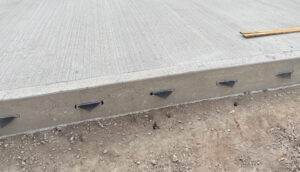
The choice of sawn jointed slabs often boils down to factors such as construction cost and ease, contractor preference and historical finishing experiences. Sawn joints, typically spaced at 6-meter intervals, offer shrinkage and contraction stress relief, converting potential random cracks into aesthetically acceptable straight-line cracks. The inclusion of bottom mesh fabric enhances load transfer via aggregate interlock, complemented by the dowel effect of mesh bars.

Challenges and Limitations
However, the edges of sawn joints are not immune to damage, particularly under heavy traffic from equipment like forklift trucks. Repairing these damaged joints can be costly and may impact the operational efficiency of industrial facilities. Additionally, the presence of sawn joints imposes limitations on racking layouts, requiring offsets that may not always align with future needs or changes in tenancy.
Comparative Analysis: Jointing Methods and Load Capacities
A comparative analysis between different jointing methods sheds light on their respective load capacities and limitations; considering factors such as moment capacities, limiting loads, and the impact on rack loading capacities. Notably, large panel fibre reinforced concrete options demonstrate significantly higher post-load capabilities compared to sawn jointed slabs, offering clients a more valuable asset with fewer maintenance concerns and fewer restrictions on racking installations.

Environmental Considerations
Beyond structural considerations, there’s a growing emphasis on environmental sustainability in construction practices. Jointless fibre reinforced concrete panels not only offer superior load-bearing capabilities but also present environmental benefits. By requiring lower concrete volumes and eliminating the need for additional mesh reinforcement, fibre reinforced concrete panels contribute to reduced embodied energy and carbon emissions, aligning with greener construction principles.
Embracing Jointless Fibre Reinforced Concrete Panels
In conclusion, the choice between sawn jointed slabs and jointless fibre reinforced concrete panels goes beyond mere construction preferences. For clients seeking long-term value, enhanced load-bearing capacity, and environmental sustainability, the adoption of jointless fibre reinforced concrete panels emerges as the superior option. By reevaluating traditional practices and embracing innovative solutions, the construction industry can pave the way for more resilient and sustainable infrastructure.
Through careful consideration and informed decision-making, the industry can shift towards a future where industrial flooring not only meets functional requirements but also contributes positively to environmental stewardship and long-term asset value.
For further information and guidance, please contact our team of experts today.