Optimised Fibre Reinforced Concrete Designs for Ports and Container Facilities
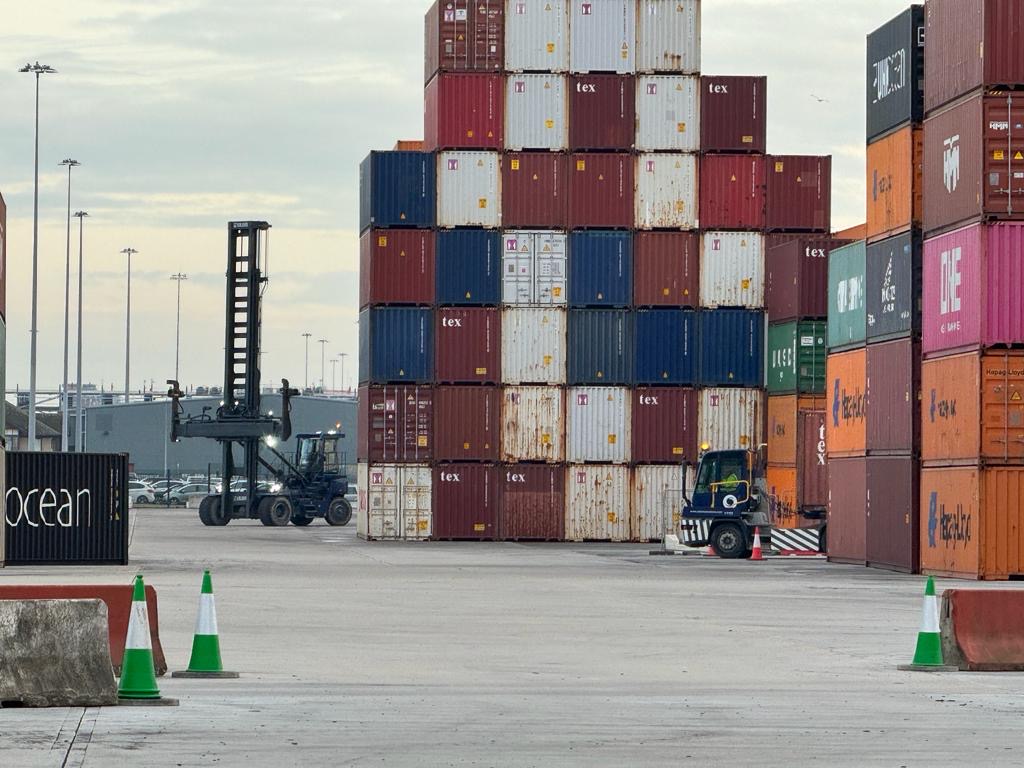
Some of the highest loads applied to concrete slabs are in port or container handling facilities, either from the stacking of containers or the movement of the container handling vehicles operating over the slab.
In such applications, careful evaluation of the design is critical to ensure the slabs are sufficiently robust to withstand this high loading, which can easily exceed 1000 kN on an area no more than 358 mm by 324 mm, with special attention required to ensure sufficient load transfer is provided at any joint in the slab if this high loading is immediately adjacent to joints.
The team at Fibre Concrete Solutions have decades of experience in designing fibre reinforced concrete, allowing us to have a full understanding of how the design of such heavy-duty slabs can be optimised.
Get In Touch
Our Approach To Fibre Reinforcement and Container Handling Facilities
Our design approach based on Concrete Society TR34 methodology, allows calculations to be checked and adopted by consulting engineers, removing the need for traditional mesh reinforcement and large-diameter dowel bars at construction joints. Many contractor construction briefs will propose an external concrete design with a single or double layer of mesh, although the position of the mesh and cross-sectional area of reinforcement can vary between projects with little explanation or reason.
If positioned in the top face, the mesh provides some control over surface cracking, but will not contribute any enhancement to the load-carrying capability of the slab. Alternatively, if the mesh is positioned in the bottom face, the slab will have enhanced sagging moment capacity and consequently sustain higher loads, but the mesh will not be able to resist contraction and shrinkage cracks in concrete at the surface nor deal with any hogging moments. By removing mesh reinforcement, the contractor can pour the fibre reinforced concrete without concerns about the placement and location of reinforcement, thereby improving the efficiency of the construction process. Access to pour areas is improved, as the delivery of concrete by the ready-mixed truck is not restricted by previously fixed reinforcement.
Fibre Reinforcement – A Cost-Effective and Robust Solution For Container Handling Facilities
As highlighted in TR34 4th edition, fibres not only increase the ultimate moment capacity at both top and bottom of the slab but are proven to increase the durability of the concrete, making an otherwise strong but brittle surface able to withstand much more impact and abrasion compared to traditionally reinforced concrete with 50mm minimum plain concrete cover. The level of increased moment capacity and ductility depends on the type and dosage of the fibre and this choice is what the experienced team at Fibre Concrete Solutions can determine, in order to establish the most robust and cost-effective design solution.
These robust and cost-effective solutions must consider load transfer at the joints if the slab thickness is to be optimised. Joints must be incorporated in the slab for construction purposes and to limit random surface cracks. In container handling facilities, the high dynamic loads trafficking joints and potential high static loads of containers placed adjacent to joints will cause an unnecessarily thick slab design to cater for the edge conditions thus created unless load transfer is available through dowel action.
Overcoming Challenges
Unfortunately, while traditional de-bonded dowel bars provide adequate load transfer and limit vertical movement for heavy loads, they also only permit movement at right angles to the joint line, whereas traditional formwork construction inevitably means infill bays between previously poured areas will want to move at 180 degrees to the formed construction joint line.

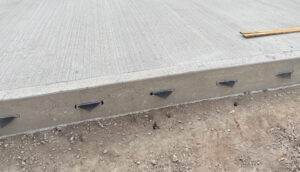
To overcome this restriction to movement, Fibre Concrete Solutions proposes the use of the Audax plate dowel system which allows lateral movement at the joint, while still providing excellent load transfer and limiting vertical movement between adjacent concrete panels, reducing the risk of the joint locking and consequent cracking into the slab. The construction of the joint is also made easier, as the installer does not have the potential issues of misaligned dowel bars, which frequently contribute to joint locking.
By checking the bursting, bending and shear capacity of the joint in conjunction with the fibre reinforced concrete the optimal slab and joint design can be realised, with the Audax plate dowels spaced to ensure the correct load transfer value is achieved.
Why Choose Fibre Concrete Solutions for Container Handling Facilities Reinforcement?
Fibre Concrete Solutions provides detailed design calculations allowing for easy checking and verification of the fibre concrete solution, and by ensuring the overall slab design is optimised, we can also reduce the environmental impact of the slab. Adopting a fibre concrete solution can significantly reduce the Embodied Energy or CO2 impact by reducing the thickness and materials required to construct the slab and potentially reducing the cut and fill operation required for the sub-base preparation.
For further guidance on how Fibre Concrete Solutions can help and advice on the design of your Container Handling Facility pavement, get in touch with the team today.