Concrete slab construction, especially in large-scale projects, demands robust solutions for load transfer and joint stability. Fibre Concrete Solutions (FCS) offers an innovative solution with our Audax and Audax HD dowel joint systems. These systems, designed for efficiency and reliability, are transforming the way concrete slabs are constructed and maintained.
Joint Design Solutions

Understanding the Basics of Audax Plate Dowels
Audax and Audax HD are sophisticated dowel systems designed to provide effective load transfer at joint locations in concrete slabs. These joints are primarily used in longitudinal construction joints but are also applicable for day joints or expansion joints with associated expansion foam. The essential goal is to manage the loads and movements in concrete slabs, reducing the risk of cracking and ensuring long-term durability.
Audax Plate Dowels: Key Features and Benefits
Two-Way Movement and Load Transfer
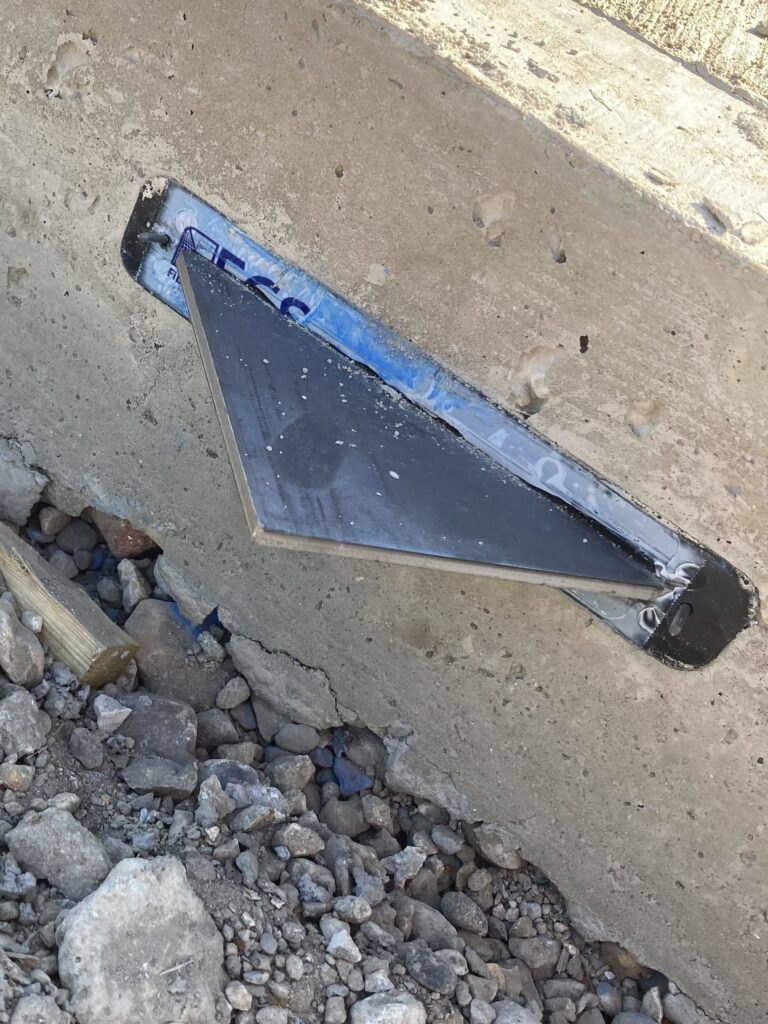
- Audax uses a rhombus (diamond) steel plate within a triangular sleeve.
- Audax HD features a square steel plate within a rectangular sleeve.
- Both designs allow horizontal movement in two directions due to drying shrinkage or thermal changes, while restricting vertical movement, crucial for calculating load transfer across the joint.
Misalignment Prevention
- Traditional dowel bars are often prone to misalignment, leading to locked joints and stress in adjacent slabs.
- The Audax system’s plastic sleeves are fixed in the correct position on the formwork during construction for the initial pour, ensuring the steel plates are perfectly aligned when inserted into the plastic sleeves prior to the pouring the adjacent concrete slabs, eliminating the common misalignment issues associated with traditional dowels.
Ease of Installation
- The bespoke dowel sleeves are simply fixed to the formwork, allowing the concrete to be poured and compacted around them.
- After removing the formwork, the steel plates can be easily inserted, readying the slab for the next pour.
Economic and Design Efficient
- Audax systems enable precise load transfer calculations, optimising slab design whether using mesh or fibres as reinforcement.
- This precision and reliability translate into cost savings compared to traditional dowel bars.


Audax Plate Dowel Installation
The installation process of Audax systems is as follows:
Choose the Formwork
Audax and Audax HD plastic sleeves are nailed into position on timber formwork and so when using steel formwork, facing the steel road-form with minimum 19mm thick ply timber will be required prior to securing the sleeves with the 50mm nails supplied with the sleeves.
Mark the Formwork
Draw a line along the centre of the formwork at half the slab thickness (h/2). Starting 300mm from the end, mark appropriate distances for joint spacing, typically up to 600mm apart.
Fix the Sleeves
Secure the Audax dowel sleeves to the formwork using the provided holes. Ensure correct spacing and alignment parallel to the formwork top.
Pour and Compact Concrete
Pour the concrete and compact it thoroughly around the sleeves to avoid voids.
Insert Steel Plates
Once the concrete has set and the formwork is removed, pierce the taped sleeve openings and insert the steel plates, ensuring proper exposure.
Pour Adjacent Slab
Proceed with the adjacent slab pour, ensuring continuity and alignment.


Contact Fibre Concrete Solutions for Audax and Audax HD Plate Dowels
Our Audax and Audax HD dowel joint systems offer an advanced, reliable, and cost-effective solution for load transfer in concrete slabs. By addressing the limitations of traditional dowel bars and providing a precise, easy-to-install alternative, these systems are setting new standards in concrete construction.
For more detailed design solutions and support, contact Fibre Concrete Solutions today.