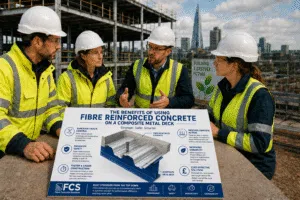
Fibre Concrete Solutions has a broad experience in the design fibre of reinforced concrete in a range of applications. This experience enables us to understand the importance of all aspects of the construction process and the attention to detail required to make a fibre reinforced concrete application successful.
The detailing and jointing arrangement of your concrete floor or pavement is often an area that is overlooked, when a simple loading calculation is provided. This detailing will dictate the long-term performance of the slab and ensure that the slab’s load carrying capabilities are correctly fulfilled.
The Vertex, Nexus and APEX range of fibres can be all be utilised in a wide range of applications with Fibre Concrete Solutions able to offer the appropriate jointing solutions to meet the job requirements.
Joints
Concrete will inevitably contract, shrink, and expand depending on its constituent materials and ambient conditions. This unavoidable movement will cause significant stresses to be developed that can induce cracking in the concrete.
The purpose of jointing the concrete is to relieve the buildup of these stresses in the concrete and, in conjunction with the addition of fibres, minimise the potential for visible random cracking. The type of joint and location will be dependent on the application, the performance required and the fibre solution adopted.
Sawn Induced Joints
Sawn induced joints offer the simplest form of concrete jointing.
A cut, typically to a depth of a quarter to one third of the concrete slab thickness, is sawn into the concrete surface within 24 hours of the concrete being cast. The distance between saw cuts will depend on column centres and aspect ratio but is typically 6 to 8 metres.
The saw cut will induce crack formation, relieving stresses in the concrete and avoiding visible random cracks. Structural performance and load transfer are maintained across the joint through a combination of aggregate interlock and the influence of fibres in the concrete.
Saw cuts are common in long strip construction techniques or in large area flood pours. Where the floor or pavement is subjected to heavy point or wheel loads, checking the potential edge and corner conditions is essential to determine whether additional load transfer mechanisms are required.
Although the amount of joint opening is dependent on the mix constituents (particularly the free water content) and ambient conditions, if the sawn joint spacing exceeds 6 to 8 metres, load transfer through aggregate interlock may be compromised and alternative joint detailing should be considered.
Dowelled Joints
A dowelled joint is used where load transfer across the joint is critical and where joint spacing may compromise aggregate interlock.
The dowel may be a round or square steel bar or plate which will be either de-bonded to one side or placed in a sleeve to allow the concrete to move at the joint. If the dowels are used in conjunction with saw cuts, the depth of the saw cut may be increased to deliberately encourage movement at the dowelled joint location.
The dowel system will have been specifically designed for the joint such that it is appropriate for the load it is intended to transfer. For a long strip construction method, best recommended practice is to utilise a dowel induced joint every third or fourth joint, with associated deeper saw cut, to encourage movement to occur where additional load transfer is available.
Armoured Joints
Armoured joints are required for the perimeter of large panel construction where the absence of sawn induced joints causes a significant opening at the joint. Such solutions are common for heavily loaded internal floor applications, resulting in a floor that has greater flexibility for loading compared to a jointed floor, and may result in a thinner slab design.
Armoured joints spaced at distances up to 50 metres, mean that the individual joints could open to 20mm. Such joint opening requires substantial load transfer between panels and protection of the joint arris, which otherwise would be liable to damage and failure over time due to solid wheel forklift traffic.
Such applications require APEX steel fibres to give the high residual tensile strength performance required in the fibre reinforced concrete.
Assistance
Fibre Concrete Solutions understands you may have specific requirements or face specific challenges with placing and finishing your fibre reinforced concrete application. Specific projects can be reviewed, to allow all aspects of jointing and detailing, together with the appropriate fibre design and solution to be proposed.
For further information or assistance, please contact us.