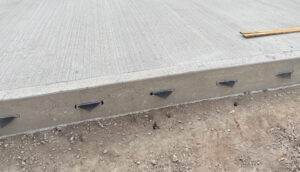
The farming industry is a major user of concrete, providing floors and hard standings for barns, yards, silo’s, access roads and other areas. These areas are required to provide a high level of durability and toughness due to the loading from farm machinery and plant.
In areas where livestock will be present or grain and foods stuffs could be stored, it is important that any concrete laid provides a safe surface which can be easily cleaned and maintained.
Construction can often take place in remote locations or where access may be limited. Therefore, the design must consider the difficulties of getting materials and equipment to the required areas.
By adopting a fibre reinforced concrete, the durability and load bearing capacity of a concrete can be increased. By eliminating the need for traditional mesh reinforcement, the construction process is simplified, and the placement of concrete made easier for the contractor.
When considering the use of fibres for farming applications, it is important for the farm owner to fully understand the types of fibre reinforcement available and the engineered solutions that these can achieve.
There are 3 commonly supplied fibre types in the UK concrete market, each having specific functions and benefits in concrete, and it is important to decide which type or types are appropriate for the application. Each fibre may then be added to the concrete in a range of dosage rates dependent on the type of fibre and purpose.
The FCS team has decades of experience in supplying fibres for every application including heavily loaded storage slabs, external pavement slabs, pre-cast concrete elements and fibre reinforced concrete topping slabs. FCS will not only provide the right product or products for the application but will provide detailed designs to demonstrate the effect of the fibre reinforced concrete together with the appropriate jointing and detailing of the slab for a successful outcome.
Our Vertex micro polypropylene fibres are typically added at 0.9 kg/m3 to concrete to provide early age benefits such as plastic shrinkage crack control and resistance to settlement in deep concrete sections. Vertex micro fibres are non-corrodible, will enhance the surface freeze-thaw resistance and reduce permeability of the concrete, even where traditional reinforcement is a structural requirement, thereby protecting embedded steel from corrosion.
For structural applications where enhancement of the load bearing capacity of the slab is required, then either our APEX steel fibres or Nexus macro fibres should be considered.
Our APEX steel fibres are typically dosed at rates from 10 to 50 kg/m3. These are used for internal storage warehouses and workshops where the floor or slab could be subjected to very heavy loading. APEX steel fibres offer the advantage of potentially increasing joint spacing by adopting large panel or “jointless” construction.
Our Nexus macro synthetic fibres can also increase the structural load bearing capacity of the concrete slab, but offer the advantage of being non-corrodible, which can enhance the durability and long term performance of the concrete in highly aggressive environments exposed to a variety of loading conditions.
Therefore, it is important to understand and clearly define what performance is required and how this is best achieved. Critically, if the use of fibres is to increase the load bearing capacity of the concrete then the specification and dosage of a fibre should be in line with the structural performance requirements given in EN14889 “Fibres for Concrete”.
The appropriate minimum dosage rates can easily be checked on the individual products declaration of performance where the “effect on strength” clearly defines the requirements for CE compliance. As an example, our Nexus 85 fibre can meet the structural requirements of EN14889-2 at a dosage rate of just 2.5kg/m3.
FCS can provide detailed design calculations, advising on the spacing, type and detailing of joints. By looking at the individual project and the construction methodology to be adopted, FCS will optimize the overall solution and tailor the fibre and dosage to meet your requirements.
For further information on how you could replace traditional mesh reinforcement with a structural fibre solution, please contact us.