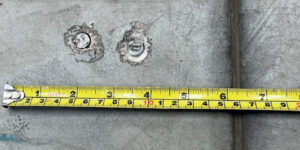
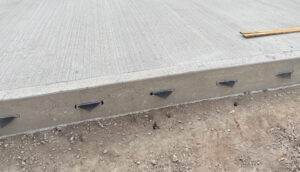
Explosive spalling occurs in dense, high strength concrete when moisture, unable to escape through natural porosity, causes internal vapour pressure to rapily rise until the concrete surface violently breaks away with an audible bang.
It has been well documented over the past 25 years that fine polypropylene fibres distributed within dense, high strength concrete can permit the release of this vapour pressure thus reducing if not eliminating the explosive spalling phenomenon.
EN 1992-1-2:2004 6.2 (2) Method D states that a dosage of more than 2 kg/m3 polypropylene fibres will mitigate the effects of explosive spalling.
However, empirical research and testing has concluded that typically 1 to 2 kg/m3 fine monofilament polypropylene fibres with diameter 15 to 32 micron is the most effective fibre dimension and the dosage rate will depend on: a) the concrete mix constituents; b) the fire curve to which the concrete is to be subjected; c) the degree of spalling (loss of surface depth or area) acceptable to the application’s design parameters.
FCS have considered all the test and practical evidence presented to the construction industry over 25 years and concluded that 32 micron diameter Vertex polypropylene fibres offer the optimum balance of resisting explosive spalling while causing the least effect to the rheology of the concrete mix into which they are added.
The dosage rate will either be 2 kg/m3, complying with EN 1992-1-2:2004 6.2 (2) Method D or determined by testing to the specified fire curve adopted for the application with the minimum dosage being 1 kg/m3.
Vertex is CE marked and complies with EN14889 pt2 Class Ia Fibre for Concrete. For a more in-depth explanation of the prevention mechanism provided by Vertex fibres in the case of explosive spalling of concrete, please contact us.